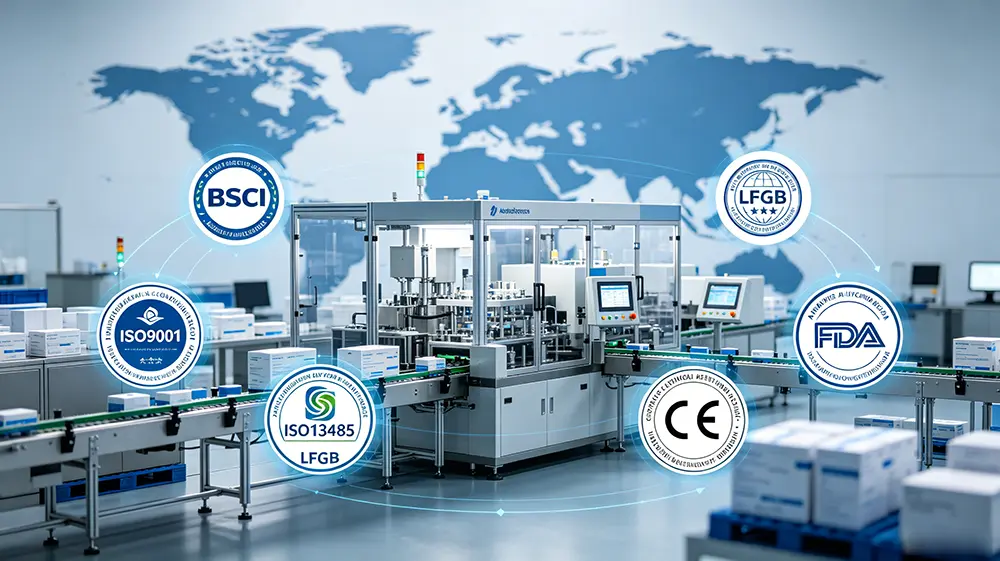
For medicine box manufacturers engaged in global export business, standardized international certifications are the core passport to enter European, American and global high-end pharmaceutical and retail markets. Professional and complete qualification certification is not only the basic threshold for customs clearance and customer audit, but also the key proof of factory production standardization, product safety and sustainable operation. The six core certifications including BSCI, ISO 9001, ISO 13485, LFGB, CE MDR and FDA are indispensable for overseas orders of medicine boxes, covering factory social responsibility, quality management, medical device compliance, European and American product safety standards.
BSCI (amfori Business Social Compliance Initiative) – Must-Have for European Offline Markets
BSCI is the most authoritative social responsibility audit standard for European retail, supermarket and pharmacy supply chains, and it is a mandatory qualification for European offline bulk orders, including mainstream customers such as Lidl and Aldi. Different from ordinary product safety certifications, BSCI focuses on the standardized operation of factories, covering working hours and salary management, child labor and forced labor prohibition, workshop fire safety, hazardous waste environmental protection disposal, staff canteen and dormitory compliance, and fully complies with the EU CSDDD Corporate Sustainability Due Diligence Directive.
The BSCI audit has no physical paper certificate, only an official audit report with five grades of A/B/C/D/E. Grade C is valid for 1 year, while Grade A and B are valid for 2 years. The report is shared on the official amfori platform, realizing one-time audit and universal recognition by multiple European customers, avoiding repeated factory audits. For British market customers, Sedex/SMETA 4-pillar audit can be used as an equivalent alternative to BSCI. E-commerce retail orders on European Amazon do not mandate BSCI, but the certification can greatly enhance factory competitiveness and order winning rate.
ISO 9001 – Global Universal Quality Management System Certification
ISO 9001 is the most basic and widely recognized quality management system certification in the global manufacturing industry. It standardizes the whole production process of medicine boxes, including raw material procurement, production processing, quality inspection, finished product storage and after-sales service. For all export medicine box factories, ISO 9001 is a basic threshold for cooperating with overseas customers, verifying that the factory has stable and standardized quality control capabilities and can consistently provide qualified products for global markets.
ISO 13485 – Mandatory Certification for Medical-Grade Medicine Boxes
As a specialized quality management system for medical devices, ISO 13485 is a compulsory certification for all custom medical-grade medicine boxes and split medicine boxes. Compared with ISO 9001, it has stricter requirements on production environment, process control, product safety and traceability, which fully meets the quality management standards of global medical and pharmaceutical industries. All medicine boxes marked with medical use for export must pass ISO 13485 certification, which is the core qualification to enter global formal pharmaceutical institutions and medical retail channels.
LFGB – Rigid Access Qualification for German and European High-End Pharmacies
LFGB is the authoritative food and material safety certification in Germany, and it is a rigid requirement for medicine boxes entering high-end pharmacies and retail markets in Germany, Switzerland and other European regions. Medicine boxes belong to direct contact materials for pharmaceutical products. LFGB certification strictly tests the migration of harmful substances, material safety and chemical stability of box materials, ensuring that no toxic and harmful substances are precipitated when contacting medicines. It is an essential certification for factories to expand high-end European medical packaging markets.
CE MDR 2017/745 – EU Market Access for Medical Medicine Boxes
The CE MDR certification under the EU Medical Device Regulation is exclusively applicable to export medicine boxes marked with medical splitting and medical use attributes. Ordinary retail packaging medicine boxes do not need this certification. To obtain CE MDR qualification, factories need to complete product testing, establish complete Technical Construction Files (TCF), and cooperate with an authorized European agent. This certification is the legal passport for medical-grade medicine boxes to circulate in the EU single market, ensuring that products comply with EU medical device safety, health and environmental protection standards.
FDA Certification – Core Compliance for US Market Exports
FDA compliance qualification is a must for medicine boxes exported to the United States (applicable to Amazon, Temu, US pharmacies and pharmaceutical enterprises). The core certifications include FDA 21CFR Part 177 food contact material DOC declaration and migration test report, California Prop 65 harmful substance test report, phthalate and heavy metal safety test. For printed medicine boxes, RoHS 2.0 ink detection report is also required.
In addition, for supporting orders of large American pharmaceutical enterprises, factories need to provide DMF Drug Master File and USP Pharmacopeia dissolution test reports. All FDA series reports verify that the medicine box materials are safe and non-toxic, will not cause secondary pollution to medicines, and fully meet US market access standards.
Conclusion
To sum up, BSCI focuses on factory social responsibility and sustainable operation, ISO 9001 and ISO 13485 guarantee standardized quality management (general and medical-grade respectively), LFGB covers European high-end material safety standards, CE MDR realizes EU medical product market access, and FDA is the core compliance threshold for the US market. The combination of these six core certifications enables medicine box factories to fully cover global mainstream markets and meet the audit and compliance requirements of ordinary retail and high-end medical pharmaceutical customers.