Why Do Magnetic Pill Organizers Fall Off the Fridge?
A magnetic pill organizer that slides off the fridge is not a magnet that failed. Review data across several listings shows the failures cluster into four patterns: a steel plate peeling off a hollow base, a stack that cannot hold two units, a mount that survives its own weight but not a slammed door, and a grip that fades after months.
None of the four is bad luck, and none is caught by the phrase suppliers actually write: “strong magnetic suction.” That phrase commits to nothing measurable, so nothing upstream gets checked. This guide breaks the four failures down and lists the specification lines that keep a magnetic pill organizer on the wall.
Four Ways Magnetic Pill Organizers Actually Fail
The steel plate peels off its base
The most documented failure is not the magnet at all. Long-term reviews of one modular system describe the same construction: a steel plate glued onto a hollow recess in the base, so the adhesive grips only around a thin edge. One owner counted roughly half the units failing within days — “it’s not just one of these that has failed.”
The joint, not the magnet, is the weak link. A sample check takes seconds: pry gently at the plate edge. If it lifts with a fingernail, the production version will not survive a year of daily pulls.
The stack will not hold
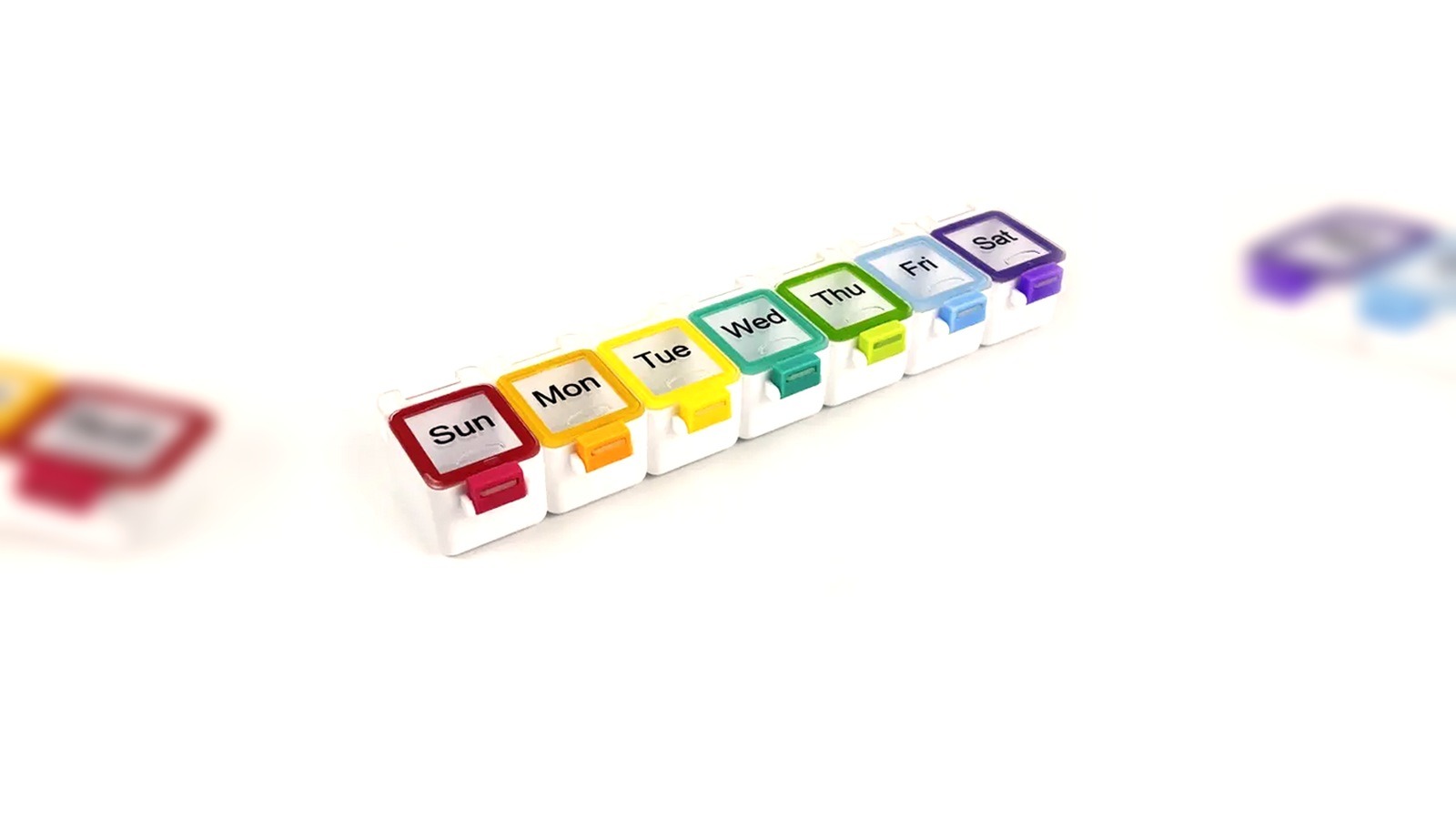
Modular designs that connect day cups or whole units magnetically fail in a second way: the mount works, the stack does not. One verified review of a stacking design reads, “the magnet for stacking is way too weak to keep the two organizers together.”
Stacking is a shear load, not a pull load. A magnet can measure well on a pull gauge and still slide apart under sideways force, which is exactly how stacked units are handled every morning. If the design stacks, the RFQ needs a shear specification, not a pull number.
It survives the shelf, not the door slam
Two independent review summaries of fridge-mount organizers reach the same split verdict. The backing is “strong enough to support a full load” and holds when bumped with a shoulder. Yet the rack “can detach from the fridge if tugged at the wrong angle,” and the grip “may not be strong enough to survive a hard fridge slam.”
A closed door sends a shock through the cabinet, and every opening adds vibration. A magnetic pill organizer only has to fail once — on the day a full week of pills is loaded — to cost a buyer a returned shipment and a review that never goes away.
The grip fades after months
Marketplace editorial descriptions now acknowledge the fourth pattern openly: “some users have reported issues with the magnet’s longevity, occasionally causing the cap to come loose.”
In assembly terms that usually means the magnet migrated inside its pocket, or the adhesive crept under load — both detectable at incoming inspection, if the plan includes re-testing kept samples.
Static Load and Impact Load Are Different Numbers
Hanging a loaded organizer is a static load: tens of grams, applied slowly, in one direction. A door slam is an impact load: the same joint loaded at several times its own weight for a few milliseconds, from whatever angle the door meets the cabinet. A magnet that passes the first can fail the second.
“Strong magnetic” specifies neither case. The magnetic-closure gift box trade learned this in its own material — one packaging supplier states that thin panels “hold in static display but fail on consumer handling within weeks.” Static display is a showroom test; consumer handling is the actual life of the goods.
Pill box closures face the identical split between “closes on the desk” and “stays shut in a bag,” as covered in which pill box latch stays shut on the road.
What the Packaging Industry Already Tests
Magnetic gift-box closures ship by the million, and the industry around them has turned closure strength into standard, quotable checks. None of the values below is a pill-box standard — they are shown as proof that these lines can be written and tested. The actual numbers for a pill box must be agreed on samples.
- A 90-degree pull test. Closure force is measured with a tension gauge pulling the lid open at 90 degrees, recorded in newtons, as a line check on every batch — because seating and panel thickness vary batch to batch.
- Drop and vibration. A 1.2 m drop (ISTA 3A / ASTM D4169) plus a vibration sweep, on the logic that sustained vibration, not just the drop, can walk a weak closure open.
- AQL sampling of the force reading. Closure force is sampled under ISO 2859-1, and a drift toward the lower limit triggers review before the batch ships — the same logic behind pill box batch consistency.
- Gauss meter on the finished assembly. Surface flux is measured on the finished box, not the raw magnet, because the housing and the air gap change the field. It is the packaging twin of a rule buyers already know: test the finished part, not the material certificate.
- Cycle and humid-heat ageing. One supplier’s release criteria: 500 open/close cycles with no measurable force loss and no magnet migration, then 48 hours at 40 °C and 90% relative humidity.
Every line above converts “strong” into a number someone signs. That is the entire difference between a feature claim and a specification.
Pull Force and Opening Force Trade Places
Magnet grade is a dial, not a mood. In the closure trade’s published comparisons, N42 runs about 18–22% stronger than N35 at the same size, and opening resistance rises with it: roughly 0.5–0.7 kgf to open an N35 flap versus 0.7–0.9 kgf for N42. Below N33 the snap feels feeble; above N42 the lid starts fighting the user.
For pill boxes, that dial lands on a documented pain point. Aggregated complaint statistics put “hard to open” at 22.6% of closure complaints — so a magnet chosen for maximum grip on the fridge is, at the same time, a magnet chosen against the weakest hands in the household.
There is also a hard ceiling. Magnetic closures are easy-open by design, which makes them a poor partner for child-resistant requirements; the two goals pull in opposite directions. Decide which market the SKU serves before tooling is cut.
Seven Lines to Put in the RFQ
- Holding force as a range, not an adjective. “X to Y newtons at 90 degrees,” with the range agreed by measuring a reference sample that both sides accept.
- Two duty cases. Static hang, defined by load and duration; plus a defined bump or door-slam simulation — one number cannot cover both.
- Shear for stacked designs. If units stack or pods sit side by side, specify sideways retention, not only straight pull.
- Steel-plate bonding. Adhesive type, minimum bonded area, and no glue-on-a-hollow-edge construction; verify with a defined pry or peel check on samples.
- Force sampling on finished assemblies. Gauss or pull readings per batch under an AQL plan, with kept samples re-tested at an agreed interval to catch fade.
- Ageing acceptance. A cycle count and a humid-heat soak, passed only with no measurable force loss and no magnet migration.
- A temperature statement. Standard N-grade neodymium magnets are rated around 80 °C in the magnet trade; confirm against real use, because a car dashboard in summer can exceed it.
End the Argument With a Sample, Not an Adjective
One packaging supplier compresses the whole problem into a sentence: “The magnet should feel strong but not too strong” is not a specification we can build to.
Pill-box buyers can end that argument the same way the gift-box trade does: send a reference unit whose closure feel everyone accepts, ask the supplier to measure and quote its force, and write that number — as a range — into the purchase specification.
A magnetic pill organizer then carries two honest claims: a force window it was built to, and a test record showing the production batch stayed inside it. Everything else, including the strongest adjective in the catalog, is marketing.