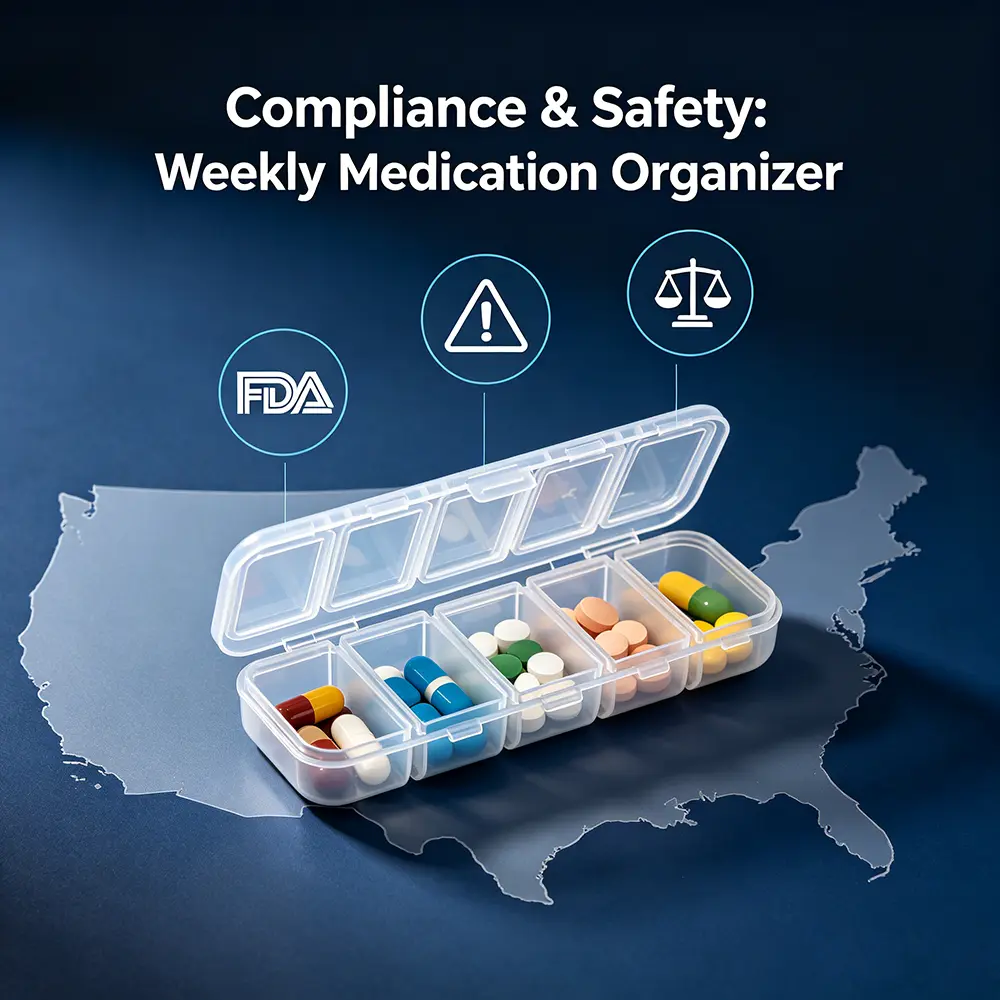
Which pill organizer is best? For manufacturers and brands, the best pill organizer is not just about user convenience—it is the one that meets U.S. safety regulations, avoids legal liability, and passes material compliance tests. While most pill organizers are not classified as medical devices, they must still comply with FDA food contact material requirements, and brands must clearly address child resistance warnings under the Poison Prevention Packaging Act (PPPA) to protect consumers and reduce lawsuit risks. This guide provides a practical regulatory roadmap for any company manufacturing, importing, or selling a pill organizer in the American market.
FDA Classification – Is a Pill Organizer a Medical Device?
Most standard pill organizer products without electronics or automatic dispensing functions are not regulated as medical devices by the FDA. However, this distinction has important legal consequences for labeling and liability.
General Purpose vs. Medical Device Status
A basic weekly pill organizer made of plastic or metal is considered a general consumer good or a medication accessory. The FDA only classifies a product as a medical device if it is “intended for use in the diagnosis, cure, mitigation, treatment, or prevention of disease.” If your pill organizer includes an electronic reminder alarm or a automatic pill dispensing mechanism, it may fall under Class I or Class II device regulations (21 CFR 890.3925). In that case, you must register with the FDA and comply with Quality System Regulation (QSR).
Practical Advice for Manufacturers
If you sell only passive plastic pill organizer boxes, do not claim medical benefits. Avoid phrases like “prevents missed doses” or “treats non-adherence.” Instead, use factual claims: “helps organize medication” or “reminder to take pills.” This keeps your product outside FDA medical device oversight and reduces compliance costs.
Poison Prevention Packaging Act (PPPA) – The Biggest Legal Trap
The PPPA (16 CFR § 1700) requires most prescription and some OTC drugs to be packaged in child-resistant (CR) packaging. However, pill organizer boxes are generally exempt. This creates a major liability risk because consumers transfer drugs from CR bottles into non-CR organizers.
What the Law Actually Says
Under 16 CFR § 1700.14, a pill organizer is not listed as a required child-resistant package. The Consumer Product Safety Commission (CPSC) has explicitly stated that pill organizers are “reuse containers” and do not need to meet CR testing protocols unless marketed for children. But this exemption does not protect you from lawsuits if a child accesses medication from your product.
Mandatory Warning Label Requirements
Even though no federal law requires CR lids on a pill organizer, CPSC guidance strongly recommends the following warning text on the packaging and product insert:
“WARNING: This organizer is not child-resistant. Keep out of reach of children.”
Failure to include this warning has been cited in multiple state-level product liability cases. For added safety, consider designing a two-step opening mechanism (push-and-turn or squeeze-and-lift) and voluntarily test your pill organizer to 16 CFR § 1700.1 CR standards.
FDA Food Contact Material Compliance – 21 CFR Parts 170-199
Since a pill organizer touches medications that users ingest, the plastic or metal materials must comply with FDA food contact substance regulations.
Approved Plastics for Pill Organizers
The most common compliant materials are:
Polypropylene (PP) – Listed in 21 CFR § 177.1520. Acceptable for all food contact. Maximum temperature 121°C (250°F).
Polystyrene (PS) – 21 CFR § 177.1640. Acceptable but brittle; not recommended for durable pill organizer use.
ABS (Acrylonitrile-butadiene-styrene) – 21 CFR § 181.32 or § 177.1040 if properly formulated. Must have residual acrylonitrile below 11 ppm.
If you use Tritan™ or other copolyesters, confirm that the supplier provides an FDA Food Contact Notification (FCN) or a Letter of Guarantee stating compliance with 21 CFR.
BPA-Free and Non-Toxic Claims
The FDA has banned BPA in baby bottles and sippy cups but does not prohibit BPA in pill organizer plastics. However, California Proposition 65 requires a warning if BPA or other listed chemicals leach above “no significant risk levels.” To avoid state-level compliance headaches, manufacture your pill organizer from BPA-free materials and obtain third-party test reports (e.g., from SGS or Intertek) showing non-detect for BPA, phthalates, and heavy metals.
Metal Pill Organizers – Special Rules
If your pill organizer is made of aluminum or stainless steel:
Aluminum must comply with 21 CFR § 175.300 for coatings or § 178.3800 for the metal itself if uncoated.
Anodized aluminum is acceptable only if the anodizing process uses FDA-approved electrolytes (no heavy metals).
Always provide a certificate of analysis showing no lead, cadmium, or arsenic migration.
California Proposition 65 – The Strictest State Requirement
Any pill organizer sold in California must comply with Prop 65, which lists over 900 chemicals. The two most relevant for pill organizers are BPA and lead (from pigments or recycled plastics).
Safe Harbor Levels and Testing
For BPA, the Maximum Allowable Dose Level (MADL) is 3 µg/day for oral exposure. A standard pill organizer with BPA-based plastic (rare today) would almost certainly exceed this. For lead, the MADL is 0.5 µg/day. Use certified lead-free colorants and avoid recycled plastics from unknown sources.
Warning Label Exemption
If your pill organizer tests below Prop 65 safe harbor levels for all listed chemicals, you do not need a warning label. Otherwise, you must include the Prop 65 warning text:
“WARNING: This product can expose you to [chemical name], which is known to the State of California to cause cancer or birth defects. For more information go to www.P65Warnings.ca.gov.”
Most national brands choose to reformulate with compliant materials rather than add this warning, which can deter sales.
Practical Compliance Checklist for Your Pill Organizer
Use this step-by-step checklist before shipping any pill organizer to the U.S. market.
| Step | Action | Responsible Party |
|---|---|---|
| 1 | Confirm material is listed in 21 CFR Part 170-199 | Material supplier |
| 2 | Test for BPA, phthalates, lead (SGS/Bureau Veritas) | Third-party lab |
| 3 | Add PPPA warning label on package and insert | Packaging designer |
| 4 | If selling in CA, test for Prop 65 or add warning | Compliance officer |
| 5 | Avoid medical claims in marketing copy | Marketing team |
| 6 | Keep compliance records for 3 years | Quality assurance |
Recommended Testing Frequency
Initial production run: Full FDA + Prop 65 panel
Every 12 months: Random batch test for lead and BPA
Any material change: Full retesting
Voluntary Standards for Competitive Advantage
Although not required, passing the following voluntary tests can differentiate your pill organizer in the market:
ASTM D3475 – Child-resistant packaging testing
ISO 8317 – International CR standard
UL 283 – For electronic reminder organizers
Common Mistakes That Lead to Lawsuits
Based on actual product liability cases, avoid these errors when manufacturing a pill organizer for the U.S.
Mistake #1 – No Child Warning Label
A 2019 settlement in Florida involved a child who opened a pill organizer and ingested grandmother’s blood pressure medication. The manufacturer had no warning label and paid $450,000. Solution: Always include the PPPA warning text.
Mistake #2 – Using Recycled Plastics
Recycled plastic from e-waste or automotive parts often contains brominated flame retardants or lead. A 2022 CPSC recall affected 50,000 pill organizer units from a Chinese factory using recycled ABS. Solution: Certify virgin food-grade material only.
Mistake #3 – Marketing as “Child-Proof”
Unless your pill organizer has passed 16 CFR § 1700.1 testing with a panel of 200 children under 51 months (85% must fail to open), do not use terms like “child-proof,” “child-resistant,” or “CR.” Even “tamper-evident” can be misleading. Solution: Use “push-button opening” or “secured lid” instead.
Exporting from China or Other Countries – Customs and Documentation
If you manufacture your pill organizer overseas, U.S. Customs and Border Protection (CBP) requires specific documentation.
Required Import Documents
FDA Prior Notice for any product contacting food/drugs (submitted via FDA’s Prior Notice System Interface)
Certificate of Free Sale from the exporting country
Bills of lading with Harmonized Tariff Code 3923.10.9000 (plastic boxes) or 7612.90.1090 (aluminum)
Test reports showing FDA compliance (kept on file for CBP audits)
Avoiding Detention at Port
CBP may detain a pill organizer shipment if the plastic has a strong chemical odor or visible discoloration. Always include a letter of analysis from the factory stating material name, FDA citation, and batch number. If you use anti-static or anti-fog additives, confirm they are listed in 21 CFR as indirect food additives.
This regulatory framework protects your business and your customers. A compliant pill organizer not only avoids recalls and lawsuits but also builds trust with American distributors and consumers. For ongoing updates, monitor CPSC recalls and FDA import alerts quarterly.