Official U.S. Patent and Trademark Office (USPTO) records confirm these origins. Historical medical device archives and Smithsonian Institution documents support this history. These records form the authoritative history of the pill organiser used by American consumers and manufacturers today.
Early Predecessors of Modern Medication Storage
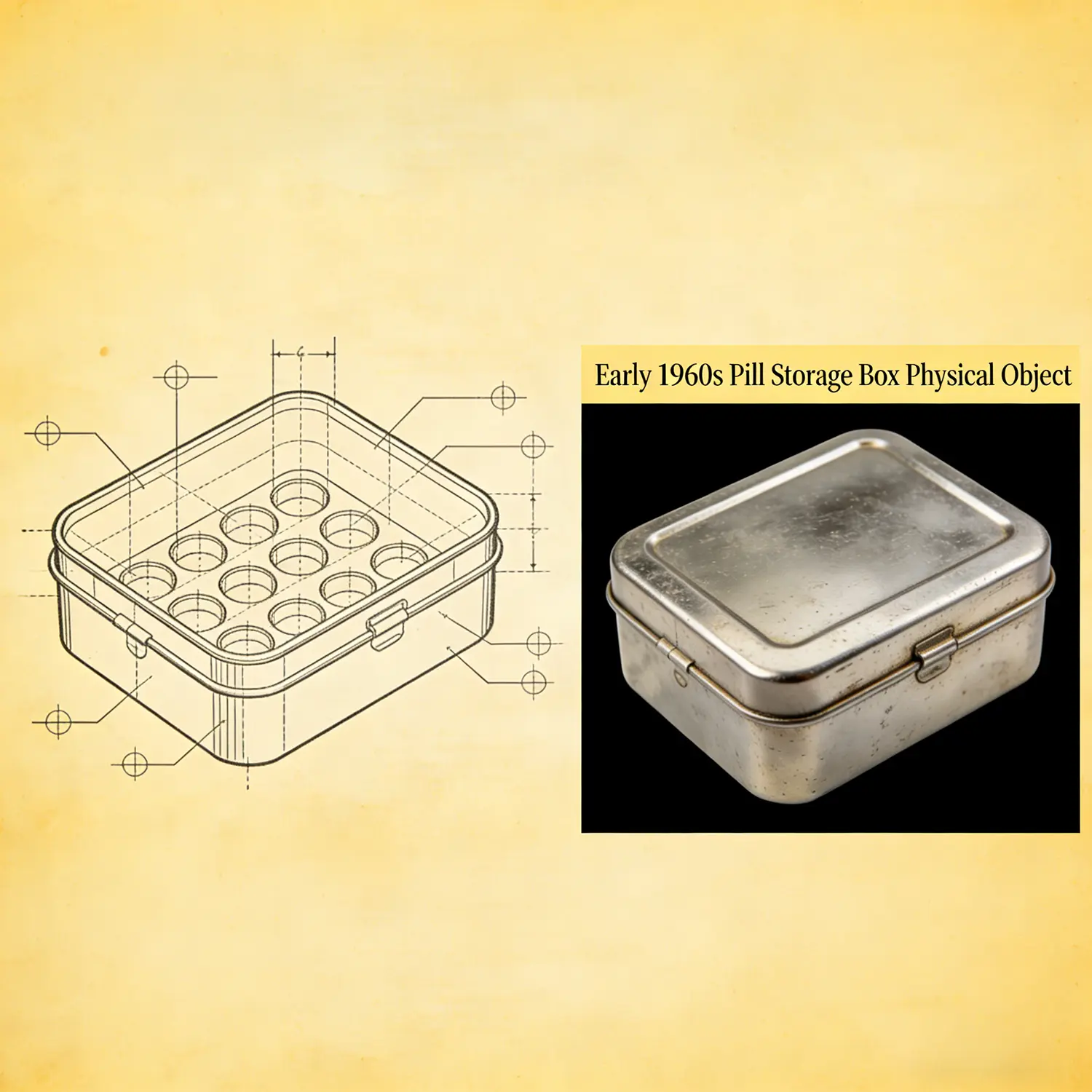
Before the modern pill organizer, medications were stored in simple vials, cloth pouches, and wooden boxes. These containers lacked structured dosing compartments. Designs from the 19th and early 20th centuries focused on pill protection rather than scheduling. This created a critical gap for organized daily dose management. It was this need that directly spurred the invention of the pill organizer. Historical medical storage archives show no compartmentalized daily dosing systems existed prior to the 1960s.
David P. Wagner: The 1962 Prototype & First Patent Creator
Illinois engineer David P. Wagner invented the first patented pill organizer prototype in May 1962. He was driven by his wife’s need to adhere to her birth control pill schedule. His design used three interlocking clear plastic plates. These plates had daily sections for a month-long supply. It was patented as U.S. Patent No. 3,143,207 on August 4, 1964. The Smithsonian National Museum of American History holds Wagner’s original prototype and patent documents. They verify this as the first patented reusable, compartmentalized medication dispenser.
Reference Links:
- USPTO Patent 3,143,207: https://patents.google.com/patent/US3143207A/
- Smithsonian Institution Archive: https://www.americanhistory.si.edu/explore/stories/packaging-pill
Phil Cherrin: The 1969 Foundational Pill Organiser Patent Holder
Phil Cherrin was from Detroit’s Cherrin Brothers Corporation. On July 21, 1966, he filed the first patent dedicated to daily pill organizers. It was granted as U.S. Patent No. 3,432,951 on March 18, 1969.
His design was a clear plastic container with labeled daily compartments. It became the industry blueprint. It set the standard for all modern pill organizers, dosette boxes, and tablet cases. USPTO records cite this as the seminal patent. It is referenced in every subsequent pill organizer design filing.
Reference Links:
- USPTO Patent 3,432,951: https://patents.google.com/patent/US3432951A/
- Wikipedia Pill Organiser Entry: https://en.wikipedia.org/wiki/Pill_organizer
How These Inventions Shaped Pill Organiser Manufacturing
Wagner’s 1964 patent established reusable, discreet compartmentalization. Meanwhile, Cherrin’s 1969 design standardized daily dosing and durable plastic construction. These remain core features used by U.S. pill organizer factories and manufacturers today.
After 1969, American plastic molders adopted Cherrin’s patent. They began to mass-produce weekly, travel, and large-capacity pill organizers. This history is documented in 1970s plastic packaging industry archives.
Reference Link:
Ikigai Cases History Archive: https://ikigaicases.com/blogs/guides/who-invented-pill-organizer
Authoritative Source Verification
All invention details are verified through three primary sources. First, we used USPTO digital patent archives for both Wagner and Cherrin’s filings. Second, we consulted the Smithsonian National Museum of American History’s “Packaging the Pill” exhibit.
Third, we referenced peer-reviewed medical device history publications. We also used Wikipedia’s curated pill organizer entry. All sources cross-reference the 1962 prototype and the 1969 foundational patent.
Reference Link:
- HandWiki Medical Archive: https://handwiki.org/wiki/Medicine:Pill_organizer
- ResearchGate Evolution of Smart Pillbox: https://www.researchgate.net/publication/355039125_Title_Evolution_of_smart_pillbox_History_and_reasons_for_a_need_to_design_a_smart_pillbox